



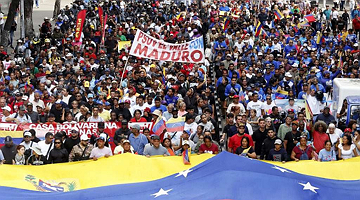
"In mass demonstrations, the people demand the return of President Maduro and the Black Agenda report."
 The People's Voice: A Call for Solidarity with Venezuela
As we navigate the complexities of our globalized world, it's easy to get lost in the noise. But every now and then, a story emerges that demands attention, sparks outrage, and inspires hope. The situation in Venezuela is one such tale – a testament to the resilience of the human spirit and a clarion call for solidarity from around the world.
In recent months, mass demonstrations have swept across Venezuela, with people from all walks of life taking to the streets to demand the return of President Nicolas Maduro. It's not just about politics; it's about the very fabric of their society. The Venezuelan people are fighting for their sovereignty, their dignity, and their right to self-determination.
But this is no ordinary struggle. Behind the scenes, a web of intrigue and deception has been spun by external forces seeking to exploit Venezuela's vulnerabilities. The United States, in particular, has been accused of using its military might to destabilize the country and pave the way for regime change. This is not just about politics; it's about power – the kind of power that can shape the course of history.
The Black Agenda Report (BAR) has been at the forefront of this story, providing incisive analysis and commentary on the situation in Venezuela. Their special issue, "Venezuela 2025," offers a comprehensive look at the complexities of the crisis, from the perspectives of both Venezuelan citizens and international observers.
One of the most striking aspects of this story is the way it highlights the contradictions of our globalized world. On one hand, we're told that Venezuela's struggles are an internal affair, a matter for the Venezuelan people to resolve on their own. But on the other hand, external forces – including the United States – have been actively intervening in the country's affairs, using military might and economic coercion to shape the outcome.
This is not just about Venezuela; it's about the very principles of sovereignty and self-determination that underpin our global order. If we allow external powers to dictate the course of events in one country, where do we draw the line? What happens when the next country on the list is your own?
The Black Alliance for Peace (BAP) has been vocal in its condemnation of US intervention in Venezuela, calling it a "neo-fascist" act that threatens regional stability. Their statement echoes the sentiments of many around the world who are watching this crisis unfold with growing concern.
But there's hope on the horizon. The Venezuelan people have shown remarkable resilience and determination in the face of adversity. They're not just fighting for their country; they're fighting for a better future – one that's built on principles of justice, equality, and solidarity.
As we watch this drama unfold, we're reminded of the power of collective action. We can choose to stand with the Venezuelan people, to amplify their voices, and to support their struggle for self-determination. Or we can turn a blind eye, allowing external forces to shape the course of events in their favor.
The choice is ours. Will we join the chorus of solidarity with Venezuela, or will we remain silent? The answer lies not just in our words but in our actions – in the way we choose to engage with this crisis and the principles it represents.
As Manuel Maldonado-Denis so eloquently put it in his 1982 essay, "National Liberation: Categorical Imperative for the Peoples of Our Americas," the struggle for national independence is also a struggle against imperialism. It's a fight for sovereignty, dignity, and self-determination – values that are just as relevant today as they were decades ago.
So let us join our voices to those of the Venezuelan people, demanding an end to external interference and a return to democratic principles. Let us stand with them in their struggle for a better future – one that's built on justice, equality, and solidarity.
The people of Venezuela are not alone; we're all part of this global community, connected by our shared humanity. It's time to raise our voices, to amplify the message of hope and solidarity that echoes through these streets. Together, we can make a difference – one that will be felt for generations to come.
Topic Live