



Unveiling the Mysteries of Dark Matter: A New High-Resolution Map Reveals Clues
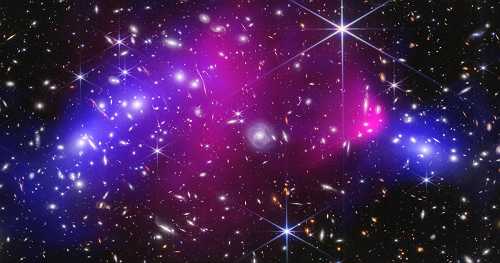 In a groundbreaking discovery, scientists have created a new high-resolution map of distant galaxies that may hold the key to understanding one of the universe's most enduring mysteries: dark matter. This invisible substance makes up over a quarter of our universe, yet its presence is only felt through its gravitational pull on visible matter.
A Map of Unseen Forces
The new map, created using images from NASA's James Webb Space Telescope, is the most detailed yet over a large patch of sky. It has twice the resolution of previous attempts and captures hundreds of thousands of galaxies over the past 10 billion years. The telescope identified nearly 800,000 galaxies, some of which were detected for the first time.
Unraveling the Mystery of Dark Matter
Dark matter doesn't absorb or give off light, making it impossible to study directly. However, scientists can observe how its gravity warps and bends the star stuff around it – for example, the light from distant galaxies. By studying these distortions across large swathes of the universe, researchers can get closer to unmasking dark matter and its various hiding places.
A Step Closer to Understanding the Universe
The study's lead author, Diana Scognamiglio with NASA's Jet Propulsion Laboratory, exclaimed, 'Now, we can see everything more clearly.' This breakthrough has significant implications for our understanding of the universe and its workings. By shedding light on dark matter, scientists may uncover new insights into the fundamental laws of physics that govern our cosmos.
The creation of this high-resolution map is a testament to human ingenuity and the power of scientific collaboration. As researchers continue to unravel the mysteries of dark matter, we may be on the cusp of a major breakthrough in our understanding of the universe. The journey ahead will undoubtedly be filled with challenges, but with each new discovery, we draw closer to unlocking the secrets of the cosmos.
Topic Live