


The Reader in the Furnace: A Study in Unburnt Truth
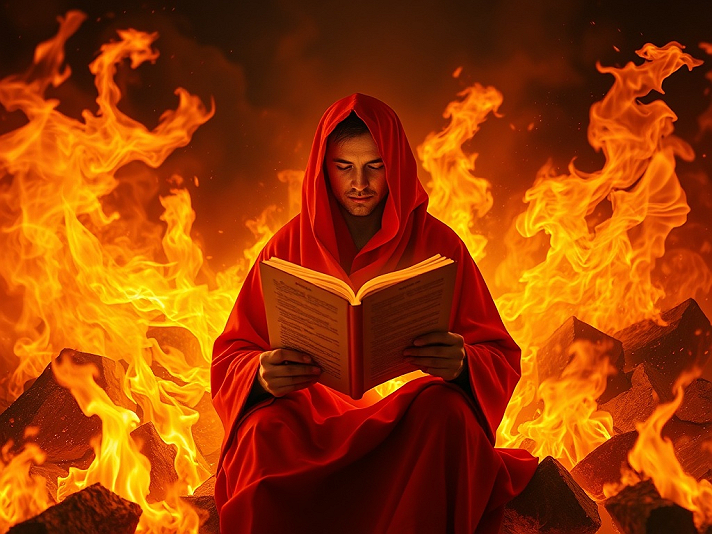
The image depicts a solitary figure cloaked in a deep crimson robe, seated cross-legged amid a roaring inferno that seems to rise from the very rocks beneath him. Flames leap and curl like living serpents, forming demonic silhouettes and draconic shapes that coil through the smoke. Yet the man remains untouched. His hood casts a shadow over his brow, but his face is serene, almost meditative, eyes half-closed in concentration as he reads from an ancient, leather-bound tome held gently in his hands. The firelight bathes him in molten gold, turning the edges of his robe into glowing embers, yet the fabric does not burn. The book itself appears illuminated from within, its pages radiating a warm, steady light that rivals the chaos surrounding it.
This is not a scene of torment but of transcendence. The man is no victim of the flames; he is their master, or perhaps their equal. The inferno is not punishment but crucible, a forge in which something is being refined. The image evokes the archetype of the mage in the abyss, the scholar who has descended into hell not to be consumed, but to read its secrets in its native tongue. Fire, traditionally the element of destruction and purification, here becomes a library. Every tongue of flame is a letter in a burning alphabet, every roar of heat a syllable in a language older than stone. The man reads not with his eyes alone, but with his entire being, absorbing knowledge that would incinerate a lesser soul.
There is a profound stillness at the center of this maelstrom. While the flames rage with primordial fury, the reader’s posture is one of absolute calm. His hands do not tremble. His breath does not quicken. This is the stillness of someone who has made peace with annihilation, who understands that to truly know something, one must sometimes allow it to consume everything else. The red robe, traditionally the color of blood, passion, and sacrifice, here becomes the garment of initiation. It is the same hue worn by alchemists in their laboratories, by cardinals in their conclaves, by executioners and revolutionaries. Red is the color of transformation, the shade that exists at the border between life and death, creation and destruction.
The book itself is the true heart of the image. Its pages are filled with text that seems almost alive, the words shifting slightly as if rewritten by the heat itself. This is no ordinary grimoire. It is the record of what fire knows: the names of stars that burned out before Earth was born, the final thoughts of witches as the pyre took them, the equations that describe how anger becomes violence becomes ash. To read such a book is to court madness, for fire has no morality, no compassion. It simply is. Yet the man reads on, undaunted, suggesting a mind that has transcended fear, perhaps even hope. He seeks truth in its rawest form, unmediated by comfort or consolation.
What makes this image so arresting is its central paradox: the co-existence of perfect calm within perfect chaos. This is the essence of certain esoteric traditions, the idea that enlightenment is not found by fleeing the world’s suffering, but by sitting down in its very midst and refusing to flinch. The flames that would reduce a city to cinders here serve as both teacher and textbook. The man’s meditation is not an escape from reality but the deepest possible engagement with it. He has chosen to immerse himself in the element that most terrifies humanity, not out of masochism, but out of a terrible curiosity, the kind that drives prophets into the wilderness and scientists into particle accelerators.
In this context, the image becomes a metaphor for the pursuit of forbidden or dangerous knowledge. The fire represents all that society deems too risky to contemplate: the void beneath consciousness, the mechanics of power, the biochemistry of evil, the mathematics of apocalypse. Most people turn away from such things, building walls of distraction and denial. But this figure has walked straight into the furnace, wrapped himself in the color of warning, and begun to read. His serenity suggests that he has discovered something crucial: that the things we fear most are not actually our enemies, but our greatest teachers, if we can learn to sit with them without burning.
Ultimately, the image is a portrait of radical acceptance. Not the passive acceptance of resignation, but the active acceptance of the warrior-sage who meets reality on its own terms. The man in red does not pray for the flames to cease. He does not cast spells to control them. He simply reads, bearing witness to the truth that fire has spent billions of years perfecting. In doing so, he becomes something more than human, something tempered and annealed by the very forces that would destroy him. The book glows brighter. The flames bow slightly, as if in recognition. And in the heart of inferno, a new kind of silence is born, the silence that comes after every illusion has been burned away, leaving only what is real.