


The Reader Unburned
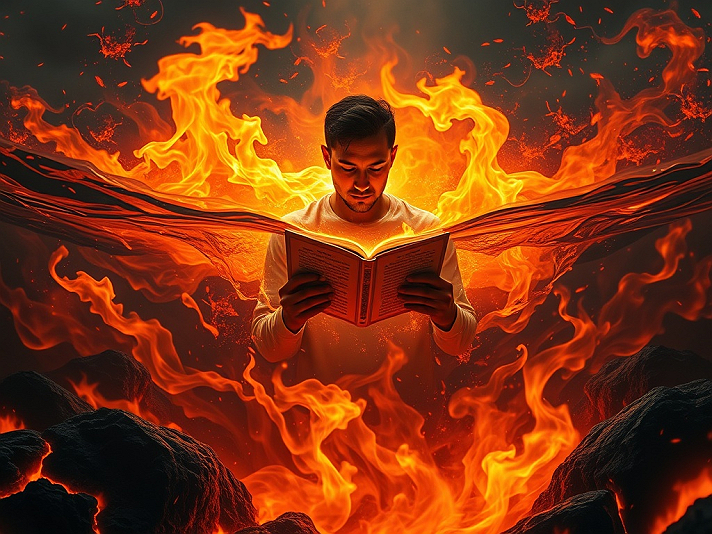
The image is a meticulously crafted digital artwork that fuses surrealism, religious iconography, and apocalyptic intensity into a single, overwhelming moment. At its center stands a solitary young man, eyes closed in serene absorption, reading an open book as though the act itself were a form of prayer. Around him, the world burns. Flames do not merely surround him; they erupt from the very air, curling like living serpents, licking the edges of the frame with incandescent fury. The fire is not random destruction—it is sculptural, almost architectural. Vast wings of flame spread horizontally behind the figure, forming a radiant halo that elevates him into something more than human: a prophet, a martyr, or perhaps knowledge itself made flesh in the midst of annihilation.
The color palette is dominated by the violent oranges, searing yellows, and deep crimsons of an inferno, yet the man remains untouched. His white shirt glows with an inner light, untouched by soot or heat, as if the fire acknowledges his immunity. The book he holds is the only other source of illumination; its pages shine with a soft, golden radiance that competes with the blaze outside. This contrast is deliberate and theologically loaded. While everything else is consumed, both reader and text endure. The image quietly quotes the biblical promise that “the word of the Lord endures forever,” even as it borrows the visual language of Revelation’s lake of fire and the burning bush that was not consumed.
Compositionally, the piece is a masterclass in controlled chaos. The flames are rendered with hyper-realistic detail—every tongue and ember is distinct—yet they never overwhelm the central figure. Instead, they frame him. The horizontal band of fire behind his shoulders creates a natural mandorla, the almond-shaped aureole traditionally used in Christian iconography to signify holiness. His bowed head and closed eyes reinforce the motif: this is not a man fighting the fire but one who has transcended it through contemplation. The rocks at the bottom, glowing red from within, suggest a volcanic landscape or the cracked floor of hell itself, yet the man stands calmly upon them as though they were marble.
There is also a subtle political undercurrent. In an age where books are banned, libraries defunded, and inconvenient truths labeled dangerous, the image becomes a defiant manifesto. The quiet act of reading—private, deliberate, introspective—becomes revolutionary when the world wants everything to burn. The fire is not just literal; it is the fire of censorship, of ideological purges, of algorithmic outrage that consumes nuance and rewards spectacle. Yet here, in the eye of that storm, a single reader remains, undisturbed, illuminated from within by the text he holds.
The artist has also played with temperature in a sophisticated way. The flames are hot, but the light that falls on the man’s face is cool, almost lunar. This impossible interplay of thermal and emotional temperature creates a moment of profound stillness. We do not hear the roar of the fire; we feel only the silence of absorption. Time stops. Apocalypse pauses out of respect for the act of reading.
Ultimately, the image is a secular icon. It takes the visual grammar of religious rapture—ascension, transfiguration, the saint surrounded by flames—and relocates it in the temple of literature. The man is not waiting for divine rescue; the book is the rescue. Knowledge, memory, and the written word form the only ark that can pass through the fire unscathed. In a culture that increasingly treats attention as a commodity to be burned for engagement, the image whispers a radical message: to read deeply, privately, and without distraction is to become fireproof.
The final, haunting implication is that the fire may not be trying to destroy the man at all. Perhaps it is trying to become him. The flames stretch toward the book like worshippers toward a relic, desperate for the light that does not consume. In the end, the image suggests, the real miracle is not that the reader survives the fire, but that the fire itself longs to learn how.